No products in the cart.


Questions?
0430 046 058
So you’re searching for the price of ceiling insulation hoping to find a quick number.
But instead, you get pages of waffle, no dollar signs in sight, and a dozen different materials, R-values, and energy efficiency claims that all somehow “depend on your home.”
And you think, ‘just tell me what this is going to cost.’
We get it.
You want a ballpark. Something real. Something that helps you figure out if this is a small job… or a second mortgage.
So in this article, we’re going to pull back the curtain.
We’ll walk you through what actually affects insulation prices, why one job might cost double the next, and why we don’t just throw fixed prices on the website like we’re selling toasters.
Stick around. This might be the most honest ceiling insulation pricing guide you’ll find.
Why We Don’t Just List a Price Online
We get asked all the time:
“How much does it cost to insulate a ceiling?”
And the honest answer is:
It depends.
That’s not a sales tactic. It’s not a clever way to dodge the question. It’s just the truth.
Think about it like this. If you called a mechanic and said, “Hey, how much to fix my car?”, without telling them the make, model, problem, or even whether it runs, they’d have to guess. And whatever number they gave you wouldn’t be helpful anyway.
Insulation is the same. We can’t give you a meaningful price until we know what we’re working with.
You might be living in a small single-storey home in Brisbane’s south, or in a two-level Queenslander with extensions, split roofs, raked ceilings and multiple access points.
You might be replacing old batts from the 90s, or insulating a brand-new ceiling from scratch. All of these variables shift the cost up or down.
So instead of guessing, we prefer to give real quotes based on real info, and we do it for free.
Let’s break it down, one factor at a time.
1. Size of Your Home (and Roof Space)
This one’s obvious. The bigger your home, the more insulation you’ll need.
A small 3-bedroom home might only need around 70 to 100 square metres of insulation. A large home could push that number to 200+ square metres, depending on the layout.
And it’s not just about square footage, it’s about usable roof space. Some homes have multiple sections, odd shapes, or areas that are hard to reach, if at all. All of that can affect how much material is needed and how much time it takes to install.
So when someone asks for a price, and we haven’t even seen the roof cavity yet, it’d be like giving a quote for painting a house without knowing how many walls it has.
Not all insulation is created equal.
There’s polyester, fibreglass/glass wool, cellulose, foil-backed options, and more. They all work in different ways, and they all come at different price points.
Polyester is what we usually recommend when a client wants premium quality, zero itch, and long-term performance. It costs more, but it lasts longer, holds its shape better, and doesn’t mess with air quality. It is the recommended insulation for those who suffer from respiratory conditions such as Asthma. It is also the preferred insulation for homes with ducting air condition, due to polyesters hydrophobic properties.
Fibreglass is cheaper and widely used. It gets the job done, but it’s more sensitive to moisture and tends to slump over time. This product can
irritate the skin and lungs and requires PPE when handling the insulation.
Then there’s cellulose, blown-in insulation that’s good for awkward and difficult spaces to access.
Each of these options has its own cost, and depending on your roof, one might suit better than another.
Sometimes we walk into a job and find old insulation that’s still good. To which, we might recommend re-evaluating in another 5 years and assess your need for roof ventilation, to make sure the hot air is escaping the ceiling cavity.
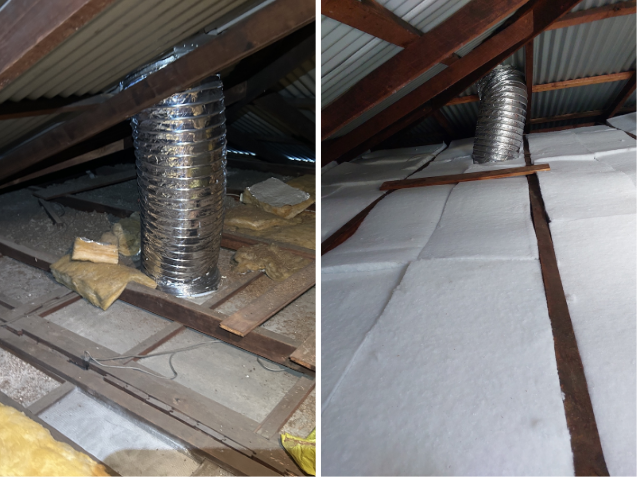
But other times, the insulation is matted, flat, lumpy, mouldy, full of dust, or worse, full of rats’ nests. In those cases, we need to remove the old material and start fresh. That’s extra labour, extra time, and yes, extra cost.
We’ve done a lot of jobs where the removal took longer than the install itself, especially in older homes with multiple layers of insulation (sometimes different types stacked on top of each other) or debris from past renovations. And we don’t recommend layering brand new insulation, on top of old.
If we haven’t looked in your roof yet, we have no way of knowing what’s hiding up there.
We’ve done installs where the roof cavity was wide open, dry, walkable and easy to work in.
We’ve also done jobs where the roof has a low pitch, covered in old electrical wiring, with joists like an obstacle course.
Access matters. If our team can move freely, the job is fast and smooth. But if the space is tight, difficult or dangerous, we have to take extra care. That means the job takes longer.
The safety of our team is paramount, even the colour of your roof (black vs cream), the house frame (steel vs timber), the roof material (asbestos, tin or tile) – can impact the team’s ability to work safely and thoroughly.
The R-value measures how well the insulation resists heat flow.
In Brisbane, most homes go for R3.5 to R4.1 for ceilings. But some go higher, especially if they want maximum energy savings.
The higher the R-value, the thicker and denser the material, and yes, the more it costs.
Choosing the right R-value isn’t about overspending or maxing out. It’s about hitting the sweet spot for your climate, your ceiling structure, and your energy goals. That’s something we help you decide during the quote process. R6 insulation, for example, is made for alpine climates and isn’t needed in Brisbane.
It’s also handy to note that good ventilation (such as whirlybirds), even the colour of your roof, impacts the homes over all R rating. Light coloured roofs have cooler ceiling cavities compared to dark colours, and roof ventilation exhausts heat out of the ceiling cavity.
Sometimes we’re not just installing insulation. We might also be:
· Installing roof vents for better airflow
· Doing partial installs due to extensions or renovations
All of that gets factored into the price.
Again, we don’t know until we’ve taken a proper look.
If you’ve read this far, you probably still want some kind of range. So here it is, very broadly:
· Basic small home: around $2,500-$4,000
· Mid-sized home: around $4,000 to $6,000
· Large home: anywhere from $6,000+
But again, these are loose estimates, it depends on removal, access and extras (i.e. roof ventilation). Every roof is different. Some are dead simple. Some are a total maze. And we won’t know which kind you’ve got until we get up there.
Here’s the Good News
We’ll check your roof space, give you real advice, and quote the job properly, for free.
No call-out charges. No guesswork. Just an honest breakdown of what it will cost, what kind of insulation suits your home, and how long it’ll take.
You can ask us questions. You can think it over. And if it’s not the right time for you, that’s fine too.
Asking “how much does ceiling insulation cost?” is like asking “how much to build a deck?” or “how much for a kitchen reno?”
It depends on what you’re starting with, what you want, and what you value most, whether that’s comfort, cost savings, or cleaner air in your home.
So instead of guessing or Googling for an average, let’s just do it properly.
Contact us today to get started.

Sales & Service

Address